
So it seems as though everyone is linking to Fidelity's study of millionaires that concluded 42% of millionaires do not consider themselves wealthy. The survey questioned 1,000 millionaires. The number the millionaires felt would make them wealthy would be $7.5 million. Roughly. Not 7.4. Ok, never mind.
It seems to me as though we're missing an interpretation. Might I add to the noise?
The links and short articles pointing to the study basically cite the sources and statistics and say something like, "poor millionaires" or "somebody call the wambulence" or "maybe we should offer them a Bud Crieser."
But where does that interpretation come from? How free are you from the same desire those millionaires have?
You see, at the root of this survey is lust or greed: it is the desire for more, the just-the-next-thing-and-then-I'll-be-fine mentality. If we're honest with ourselves, are we not suffering from the same thing? I know I am. I am constantly finding my brain wonder from level to level. Once I finish school, once I get into grad-school, once I get noticed by someone, once I get enough money, etc, etc, etc...
This study should not be so shocking. Human nature is to desire more. Money complicates this desire and feeds it.
But Christianity has this great virtue called, "godly contentment." And of course the theologian Sheryl Crow sums it up the best: "It's not having what you want, It's wanting what you've got." I'm not old by any sense, but I have learned that no matter where I get to, what level I rise to financially, I'll always want more and believe that in having more I'll be happier. But sometimes we need to listen to the wisdom of St. Biggie: "Mo' money, mo' problems."
Also, can we realize that 58% of the millionaires did consider themselves wealthy? Maybe Sheryl is one of them...
Monday, March 14, 2011

Michael Jackson and Paul McCartney Get Along
Again, people, this is precisely what the Internet is for. MJ and McCartney doing dishes somewhere.
 HT: Twenty-Two Words

Sunday, March 13, 2011
A Summary of All Good and Evil
Perhaps the most famous line in Genesis is in chapter 50, verse 20 where Joseph says to his brothers: "As for you, you meant evil against me, but God meant it for good, to bring it about that many people should be kept alive, as they are today."
Beautiful. What was meant for evil is actually being used for the best possible good of everyone. We tend to use that verse to make us feel better about crappy things that happen. Like earthquakes. But sometimes that verse isn't enough. You read words of survivors and then you read those and you think, Ugh, I don't know about that. Is it that simple? Ok, maybe you don't, but I certainly do.
But what if it was bigger than that? When I look at that verse, I see that Joseph said it. However, placing that sentence in the greater Biblical narrative, I see the Greater Joseph, Jesus Christ, saying that exact line at the conclusion of all things or....right now.
Place those same words on the lips of Christ: "As for you, you meant evil against me, but God meant it for good, to bring it about that many people should be kept alive, as they are today."
Fits pretty well, huh? Evil was done to Jesus. Injustice was done to Jesus. Jesus lived and died surrounded by evil. And yet...He raises and it is very good news indeed.
So many people ask, "Why did God let this world go to crap?" But what if it wasn't going to crap? What if our definitions of "alive" and "good" and "evil" are elementary and only half-correct? What if God is actually in control?
It doesn't seem like it. It really doesn't, does it? I cannot look at some pictures. My stomach hurts when I read some of the words of people suffering through the world. Evil is everywhere and I seem to have no one to blame but the One in "control." My instinct is that, when I review the history of the world, there is more punishment and crime than any world could handle. My instinct says that there is only evil.
But when we think we know that to be untrue. There is beauty and brokenness, righteousness and wickedness, good and evil. My idea is this: instead of using this verse to explain evil (something we love to try our hand at), could it be used in a greater way - to comfort us amidst evil?
Listen to His words, the Greater Joseph, once again and in context:
Beautiful. What was meant for evil is actually being used for the best possible good of everyone. We tend to use that verse to make us feel better about crappy things that happen. Like earthquakes. But sometimes that verse isn't enough. You read words of survivors and then you read those and you think, Ugh, I don't know about that. Is it that simple? Ok, maybe you don't, but I certainly do.
But what if it was bigger than that? When I look at that verse, I see that Joseph said it. However, placing that sentence in the greater Biblical narrative, I see the Greater Joseph, Jesus Christ, saying that exact line at the conclusion of all things or....right now.
Place those same words on the lips of Christ: "As for you, you meant evil against me, but God meant it for good, to bring it about that many people should be kept alive, as they are today."
Fits pretty well, huh? Evil was done to Jesus. Injustice was done to Jesus. Jesus lived and died surrounded by evil. And yet...He raises and it is very good news indeed.
So many people ask, "Why did God let this world go to crap?" But what if it wasn't going to crap? What if our definitions of "alive" and "good" and "evil" are elementary and only half-correct? What if God is actually in control?
It doesn't seem like it. It really doesn't, does it? I cannot look at some pictures. My stomach hurts when I read some of the words of people suffering through the world. Evil is everywhere and I seem to have no one to blame but the One in "control." My instinct is that, when I review the history of the world, there is more punishment and crime than any world could handle. My instinct says that there is only evil.
But when we think we know that to be untrue. There is beauty and brokenness, righteousness and wickedness, good and evil. My idea is this: instead of using this verse to explain evil (something we love to try our hand at), could it be used in a greater way - to comfort us amidst evil?
Listen to His words, the Greater Joseph, once again and in context:
"Do not fear...you meant evil against me, but God meant it for good, to bring it about that many people should be kept alive, as they are today. So do not fear; I will provide for you and your little ones." Thus he comforted them and spoke kindly to them.Let your fear subside as you let Him comfort and speak kindly.
Saturday, March 12, 2011
C.S. Lewis is More Popular Than Ever
And that could be a bad thing.
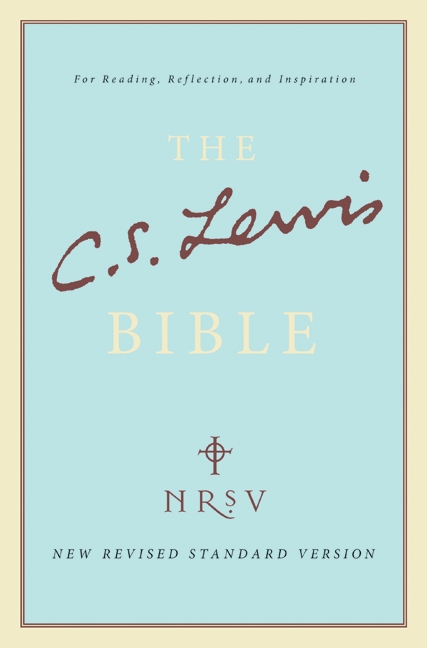
Last week, the New York Times ran a story about HarperOne's new C.S. Lewis Bible, which I am a tad wary about.
Mark Oppenheimer, who wrote the story, presents the new Bible with heavy skepticism, taking every opportunity to slight Lewis, including a mis-placed and inconsistent rebuke of Lewis's famous "Liar, Lunatic, Lord" apologetic. All of that aside, I think Oppenheimer brings up a more important idea: Lewis is being sold as a personality cult.
 The C.S. Lewis Bible is a simple idea: publish a Bible and throw Lewis quotes from both his published and unpublished works next to verses or sections of Scripture. It's somewhat helpful and I really don't have much against it. Harper is a publishing company that makes most of their money off of the 150,000 Mere Christianity copies they sell every year - they're making another C.S. Lewis buck. I get that.
But there is still a problem.
I get worried about using quotes that are put in places Lewis never intended them to go. It's like putting just "Carry That Weight" on the Best of the Beatles album; It wasn't meant to go there, it was meant to be one piece of the greater work called Abbey Road. And it needs to stay there. In fact, it doesn't really make sense unless it is there.
People will buy this Bible and read more of the Bible and Lewis and that's great. But they won't necissarily get either in its proper context. For example, many people mis-read and mis-interpret Lewis (like many Christian thinkers) by taking a single quote out of an entire work. Lewis is a brilliant writer because his books tell stories, make arguments, and build theologies over an entire piece.
My worry is that people will continue to say, "I love C.S. Lewis," when they really love the idea of C.S. Lewis from the quotes they get from their Twitter feed or C.S. Lewis Bible. This is not the end of the world or the end of Lewis by any means, I just don't think it's very helpful for readers of the Bible or of Lewis.
Lewis wrote great, complete books and we should read them, not cut them up and sell them in different packages.
Last week, the New York Times ran a story about HarperOne's new C.S. Lewis Bible, which I am a tad wary about.
Mark Oppenheimer, who wrote the story, presents the new Bible with heavy skepticism, taking every opportunity to slight Lewis, including a mis-placed and inconsistent rebuke of Lewis's famous "Liar, Lunatic, Lord" apologetic. All of that aside, I think Oppenheimer brings up a more important idea: Lewis is being sold as a personality cult.
But there is still a problem.
I get worried about using quotes that are put in places Lewis never intended them to go. It's like putting just "Carry That Weight" on the Best of the Beatles album; It wasn't meant to go there, it was meant to be one piece of the greater work called Abbey Road. And it needs to stay there. In fact, it doesn't really make sense unless it is there.
People will buy this Bible and read more of the Bible and Lewis and that's great. But they won't necissarily get either in its proper context. For example, many people mis-read and mis-interpret Lewis (like many Christian thinkers) by taking a single quote out of an entire work. Lewis is a brilliant writer because his books tell stories, make arguments, and build theologies over an entire piece.
My worry is that people will continue to say, "I love C.S. Lewis," when they really love the idea of C.S. Lewis from the quotes they get from their Twitter feed or C.S. Lewis Bible. This is not the end of the world or the end of Lewis by any means, I just don't think it's very helpful for readers of the Bible or of Lewis.
Lewis wrote great, complete books and we should read them, not cut them up and sell them in different packages.
Friday, March 11, 2011
I Actually Learned Something in California
This past week was spent in sunny, 70+ degree California for the Catalyst West Conference in Irvine. The conference was great, but the "extra-curricular activities" could have been what made it for me. I laughed really hard, I spoke deeply with friends about the things of God and His church, and I got to hear peoples' heart for the world.
I was also able to see my brother in his element, Hollywood. Please make sure you read his work around all the movies he sees. Being where he is, it's cool to see his work improve and get noticed more.
On Thursday, I was able to meet with the leadership of David C. Cook publishing and hear their vision for books and the future of making things public. They were gracious people and very affirming. I'm not sure where that relationship will go, but I benefited greatly from the hour and a half I spent with the Cook team.
But I must say, Joy Dombrow, who was with us on the trip, put it best in her summary of learnings which she showed us on the plane ride home from the conference:
I got tons and tons of great information and awesome inspirational talks through the conference, but the one word that was driven home to me was faithfulness. God does not call us to fame, but faithfulness. On the surface of this, we think it to be boring. But through the testimonies of a few men at the conference as well as some ministry experience under your belt, you tend to see it differently: being faithful is extremely difficult.
Because at the end of the day, I want a leg up, I want people to recognize me, and I want to be brought into some type of societal spotlight where people acknowledge me. And I in my weakness, I will do whatever it takes to get there: tell half-truths, not mention some things, speak more than listen, etc.
This past week I've been hit with the reality that Jesus, who had the deserved spotlight, gave that up and became a no-one, a man of sorrows, a carpenter's son from a small town in order that I might get the Best Light shining on me. Not the light from the world, but the Light of the World.
Because Jesus stepped away from the light into utter darkness, I am in the Light. And while I may go through my whole life without the limelight, I will not go another day without the True Light.
Being faithful to that reality and serving God through it is way more beneficial that letting the masses tell you who you are. No matter the cost.
Catalyst West 2011 from Willamette Christian Church on Vimeo.
I was also able to see my brother in his element, Hollywood. Please make sure you read his work around all the movies he sees. Being where he is, it's cool to see his work improve and get noticed more.
On Thursday, I was able to meet with the leadership of David C. Cook publishing and hear their vision for books and the future of making things public. They were gracious people and very affirming. I'm not sure where that relationship will go, but I benefited greatly from the hour and a half I spent with the Cook team.
But I must say, Joy Dombrow, who was with us on the trip, put it best in her summary of learnings which she showed us on the plane ride home from the conference:
"The path of faithfulness is preeminent, even if it leads to a life of perceived mediocrity instead of public prominence."That is huge. And extremely well written. (By the way, if you want more gems like that, you should read Joy's blog).
I got tons and tons of great information and awesome inspirational talks through the conference, but the one word that was driven home to me was faithfulness. God does not call us to fame, but faithfulness. On the surface of this, we think it to be boring. But through the testimonies of a few men at the conference as well as some ministry experience under your belt, you tend to see it differently: being faithful is extremely difficult.
Because at the end of the day, I want a leg up, I want people to recognize me, and I want to be brought into some type of societal spotlight where people acknowledge me. And I in my weakness, I will do whatever it takes to get there: tell half-truths, not mention some things, speak more than listen, etc.
This past week I've been hit with the reality that Jesus, who had the deserved spotlight, gave that up and became a no-one, a man of sorrows, a carpenter's son from a small town in order that I might get the Best Light shining on me. Not the light from the world, but the Light of the World.
Because Jesus stepped away from the light into utter darkness, I am in the Light. And while I may go through my whole life without the limelight, I will not go another day without the True Light.
Being faithful to that reality and serving God through it is way more beneficial that letting the masses tell you who you are. No matter the cost.
Catalyst West 2011 from Willamette Christian Church on Vimeo.
Subscribe to:
Posts (Atom)
